We live in an increasingly precarious world.
Americans, who have long assumed post-1945 international and national stabilities of government, environment, and economy, have begun to expect not prosperity but catastrophe.
Ecocide, genocide, homicide, menticide – which is radical evil? The banality of evil? Or is there only social harm, never fully unconditioned, and therefore no such thing as evil? Instead, are the ways that racial, gender, sexual, and class stereotypes turn any other into a monster themselves evil? For philosopher Susan Neiman, how we answer such questions determines how we define ourselves as civilized, as modern, as good.
Yet as twenty-first century beings in the world, our human agency has never before been as globally interconnected – your post could go viral – or as locally diffuse – your face-to-face interactions keep diminishing – as in the present.
What ought we to do?
If the contemporary world begins where the quest to justifie the wayes of God ends, then it moves us toward an overwhelming question…
“Am I evil?”
What do they answer, what do they do differently, when Hannah Arendt, Cornel West, Franz Fanon, Robert McNamara, Anna Kavan, Susan Sontag, Jane Schoenbrun, Jean-Michel Basquiat, Peter Singer, cognitive neuroscientists, sociologists, criminal psychologists, artists, and everyday people ask themselves that question?
What will you?
Moral philosophy, modern theology, fiction, poetry, graphic novels, horror films, visual art, journalism, and video games are brought to bear upon the questions of good and evil in our time. In examining more deeply what at midnight can initially seem frightening, monstrous, or taboo, we take on the moral challenge of reengaging our world and ourselves into the wider, more inclusive dawn of a brighter tomorrow.
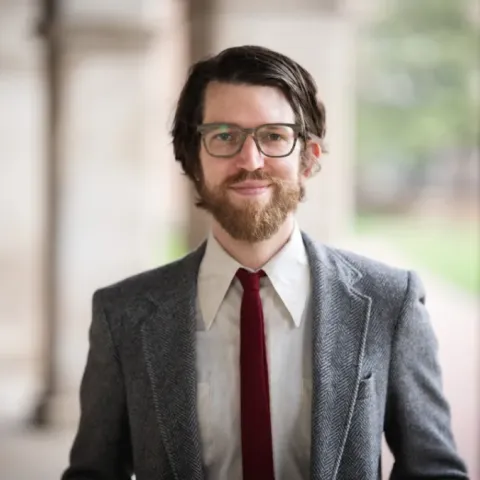
Dr. Michael J. Sanders is broadly interested in multi-ethnic American literature and culture; religion and literature; science and literature; and how U.S. Supreme Court cases that highlight race and ethnicity have influenced American literature. An interdisciplinary scholar, Sanders also continues to emphasize race and ethnicity in his work in the fields of writing pedagogy, non-Western intellectual history, banned books, queer literature, speculative literature, and religious studies.