
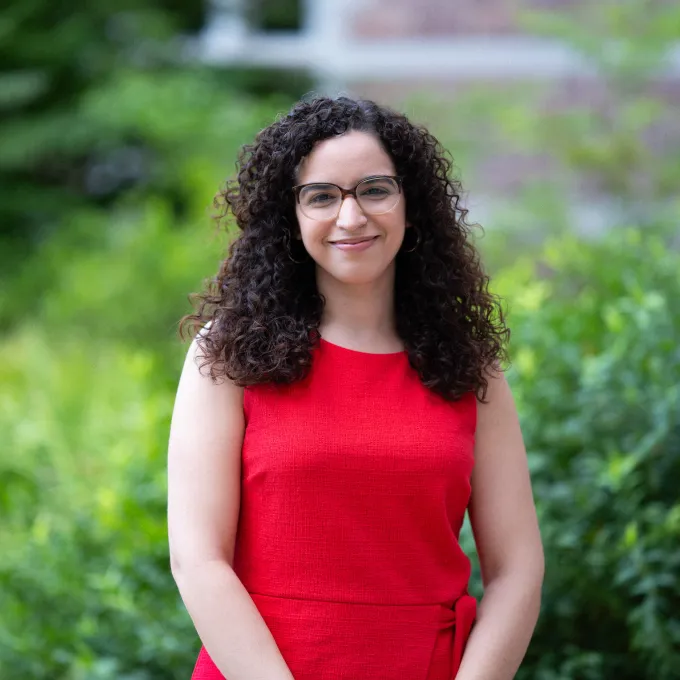
Yafrainy Familia is an interdisciplinary scholar of Caribbean and Latinx cultural studies, transnational feminisms, and critical geography.
Her research and teaching interests include 20th and 21st century Caribbean and Latinx art and visual culture; literary studies; Black and Afro-diaspora studies, feminist geography; gender and sexuality studies; curatorial practices; and digital humanities.
An Assistant Professor of Spanish and American Culture Studies at Washington University in St. Louis, she earned her Ph.D. from the University of Virginia, where she was an Interdisciplinary Doctoral Fellow in Caribbean Literatures, Arts, and Cultures. She also holds a master’s degree in creative writing from Universitat Pompeu Fabra in Barcelona.
Professor Familia’s book in progress, “Unruly Terrains: Feminist Geographies in Caribbean Visual Worlds,” examines how contemporary Caribbean women artists mobilize visual culture to contest oppressive spatial orders and envision wayward practices of geographic freedom. Bringing together painting, photography, collage, oral history interviews, and archival materials, the book traces a group of twentieth- and twenty-first-century artists whose work illuminates Caribbean women’s geographic knowledge and experience, revealing spatial imaginaries that unsettle colonial and racialized formations of space. The project approaches visual culture as both a site of representation and a mode of spatial theorization. In doing so, it demonstrates the central role of contemporary art in reconfiguring the terrains that shape Caribbean women’s struggles for gender equity, racial justice, and geographic liberation.
Professor Familia’s work has been supported by the Institute for Studies on Latin American Art (ISLAA) and the Center for Global Inquiry and Innovation, among others. Her academic and critical writing has appeared or is forthcoming in Meridians: feminism, race, transnationalism and the exhibition catalogue of Diasporic Collage: Puerto Rico and the Survival of a People, an art exhibit she helped organize as a Solidarity Fellow in the Diaspora Solidarities Lab, a Mellon-funded digital humanities and community-engaged project supporting solidarity work in Black and ethnic studies.